
Critical Communications Conference: Adelaide 17 September, 2026
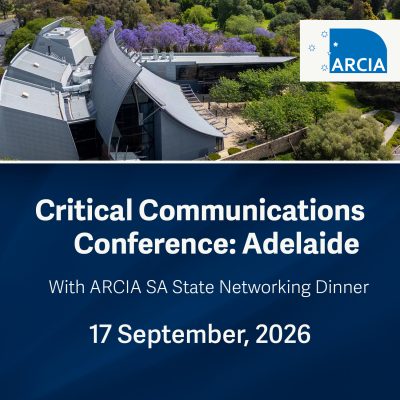
Join us in Adelaide for ARCIA’s Critical Communications Conference and the SA State Networking Dinner in September 2026.
Join us in Adelaide at the National Wine Centre for the ARCIA Critical Communications Conference on Thursday, 17 September.
Don’t Miss Out – Book Conference Tickets Now
The program is jam-packed with radio and critical communications presentations.
Finish off the day by getting together with your peers at the SA Networking Dinner, where the highly anticipated winner of the SA Professional of the Year Award will be announced. You can make a nomination for this State Award via the ARCIA website until 21 August, 2026.
Dinner ticket sales closed Thursday, 10 September.
———————————————————————————————————————————-
Event Details
Conference and SA State Networking Dinner: Thursday 17 September 2026
Venue: The National Wine Centre, Corner of Botanic and Hackney Roads, Adelaide, Australia.
Time: 9:00am – 4:30pm (Conference), 6:00pm – 10:30pm (SA State Networking Dinner)
Download Conference Program
Numbers will be strictly limited due to venue capacity for the conference and the dinner, so book your seats for you and your colleagues ASAP.
Stay updated on event information by following us on LinkedIn or subscribing to our Mailing List.
———————————————————————————————————————————-
Membership and Partner Information
Discounts apply to all rates for current ARCIA Members. Not a member yet? Join ARCIA now >>
Sign up to become an ARCIA Member and save $$$ on every ticket purchased.
ARCIA Partners: Use the partner ACCESS CODE to unlock your allocated complimentary tickets. For assistance, contact [email protected].
Adelaide 2026 Conference Stream | 9.00 AM – 4.30 PM
If you would like to be the first to know about conference announcements, follow us on LinkedIn or subscribe to our Mailing List.
- Building the SA Ambulance Emergency Operations Centre | Grant Rieger, Manager Communications Systems, Critical Systems, SA Ambulance Service & Kestrel Blackmore, General Manager, Critical Systems, SA Ambulance Service
- Big Data and AI for Mission Critical Communications – Exploring the True Potential in Australia | Ashwin Dinkar, VP – Defence & International Business, Eventide Communications LLC
- Standards Progress for LMR to Hybrid Narrowband & MCPTT Solutions | David Deacon, CEO and Founder, Etherstack
- When Triple Zero Isn’t the Problem: The Last Mile of Emergency Communications | Matthew Wormald, Chief Superintendent, Operational Communications, Fire and Rescue NSW
- Selecting the Correct Point-to-Point Microwave Solution for Your Application | Eddie Stephanou, Regional Technical Manager AU/NZ & Pacific, Cambium Networks
- Star Wars, The LEO Strikes Back – An impartial review of the satellite industry revolution currently underway | Dale Stacey, Managing Director, SAT Pty Ltd
- Private 5G: Deterministic Connectivity for Autonomous Operations Where Downtime Isn’t an Option | Malcolm Jones, Principal Consultant – Wireless Business, Vocus
- Drone-in-a-Box for Emergency Services: Resilient Connectivity Beyond Terrestrial Networks | Riley Porteous, Communications Systems Team Leader, Surf Life Saving
- Saving Lives with GIS – Using GIS for situational awareness to display narrow-band locational services | Chris Stevens, Managing Director, Cartg GIS
- Expert panel discussion: The Evolving Radio and Critical Communications Ecosystem – How Disruptive are Emerging Technologies? Moderator: Chris Stevens
Panelists: Dale Stacey, Malcolm Jones, David Deacon, Matthew Wormald
———————————————————————————————————————————-
Building the SA Ambulance Emergency Operations Centre
Presented by: Grant Rieger | Manager Communications Systems, Critical Systems, SA Ambulance Service & Kestrel Blackmore | General Manager, Critical Systems, SA Ambulance Service
This presentation will provide an overview of the planning, design and delivery of the new South Australian Ambulance Service Emergency Operations Centre.
The presentation will focus on the engineering journey behind the project — from understanding operational requirements and developing the design methodology, through to implementation, integration and transition into live operations.
Rather than focusing solely on individual technologies, the presentation will explore how resilience, redundancy, simplicity and operational readiness influenced the design and delivery of a mission-critical emergency communications environment.
———————————————————————————————————————————-
Big Data and AI for Mission Critical Communications – Exploring the True Potential in Australia
Presented by: Ashwin Dinkar | VP – Defence & International Business, Eventide Communications LLC
This topic explores how AI can and is already transforming the use of historic and near-real time Big Data (say from a GRN or a Telco provider) into useful and easily manageable chunks for proactive and predictive actional intelligence in Public Safety, Emergency Services, Utilities and Mining. We also explore unusual success stories of shared data and how AI has revolutionised the cost of hosting data in the cloud in 2026.
———————————————————————————————————————————-
Standards Progress for LMR to Hybrid Narrowband & MCPTT Solutions
Presented by: David Deacon | CEO and Founder, Etherstack
This session will offer an update on international deployments of mission-critical LTE solutions overlaying traditional LMR networks, for the public safety, utility and resources market. It will touch on advances in 3GPP, ETSI & TIA standardisation activities, TETRA, APCO P25, DMR and analogue network interworking with 3GPP standards-based MCX solutions from major vendors. Finally, it will provide technical and commercial recommendations for organisations looking to move to procurement of PTT over LTE technologies, to ensure value for money and flexibility to avoid vendor lock-in.
———————————————————————————————————————————-
When Triple Zero Isn’t the Problem: The Last Mile of Emergency Communications
Presented by: Matthew Wormald | Chief Superintendent, Operational Communications, Fire and Rescue NSW
Recent telecommunications outages highlighted the importance of maintaining access to Triple Zero (000), but receiving the call is only the beginning. Emergency response depends on the ability to move critical information from the communications centre to crews in the field. This presentation examines the control room perspective on communications resilience and how technologies including 4G, 5G and satellite connectivity provided alternative pathways when traditional networks were disrupted. Through a practical case study, attendees will gain insight into the importance of communications diversity, operational resilience, and ensuring that incident information continues to reach responding appliances when it matters most.
———————————————————————————————————————————-
Selecting the Correct Point-to-Point Microwave Solution for Your Application
Presented by: Eddie Stephanou | Regional Technical Manager
This presentation provides a practical, engineering-focused guide to selecting the correct Point-to-Point (PTP) solution by examining the core factors that determine performance: distance, required capacity, environmental conditions, spectrum availability, and operational criticality.
It outlines key terminology such as FDD vs TDD, licensed vs unlicensed spectrum, channel sizing, fade margin, space diversity, and multi-band architectures, while comparing configuration options and use cases across.
The session is designed to equip attendees with the knowledge to design reliable, high-capacity wireless links using tools like LINKPlanner and to understand how different PTP technologies fit real-world applications ranging from enterprise connectivity to backhaul and critical infrastructure.
———————————————————————————————————————————-
Star Wars, The LEO Strikes Back – An impartial review of the satellite industry revolution currently underway
Presented by: Dale Stacey | Managing Director, SAT Pty Ltd
There is a revolution taking place within the Low Earth Orbit (LEO) sector of the broadband communications industry. The sector is volatile and disruptive, with implications for the terrestrial mobile networks and traditional thinking of backhaul for the carriers, for Public Safety Users and for domestic and commercial users being challenged. This sector of communications has seen exceptional growth recently, with the costs of sat comms tumbling. However, there are whispers about congestion, a bandwidth ceiling, possible increasing costs and concerns over sovereignty and weaponisation.
This presentation is a snapshot in time of now and some crystal balling as to where it will go.
———————————————————————————————————————————-
Private 5G: Deterministic Connectivity for Autonomous Operations Where Downtime Isn’t an Option
Presented by: Malcolm Jones | Principal Consultant – Wireless Business, Vocus
Malcolm will share the story of a recent private 5G deployment delivered for a major Australian industrial operator. The project demonstrates how private wireless networks are enabling safer, more connected, and more efficient operations, and provides valuable lessons for organisations considering their own digital transformation journey.
———————————————————————————————————————————-
Saving Lives with GIS – Using GIS for situational awareness to display narrow-band locational services
Presented by: Chris Stevens | Managing Director, CartGIS
Real-time GIS and situational awareness give organisations the ability to simultaneously integrate, analyse and display streaming data from applications, devices, and weather and senor data. It provides location-based analytics that automatically refine and focus real-time data to accomplish the operational outcomes with up-to-the-minute intelligence on what’s happening in the field, and across jurisdictions. Surf Life Saving New Zealand (SLSNZ) is utilising real-time GIS via an ESRI ArcGIS Enterprise System. This system is integrated with DMR, cellular and satellite location services as well as operational data from SLSNZ’s operational applications, aeronautical and maritime traffic. This case study will focus on what SLSNZ has been able to achieve in delivering a situational awareness and incident management platform for improving operational effectiveness.
———————————————————————————————————————————-
Drone-in-a-Box for Emergency Services: Resilient Connectivity Beyond Terrestrial Networks
Presented by: Riley Porteous | Communications Systems Team Leader, Surf Life Saving
This presentation will provide a technical overview of a deployable Drone-in-a-Box (DIAB) trailer capability designed for sustained, off-grid emergency operations across NSW and broader Australia. The platform integrates dual LEO (Starlink) terminals and bonded 4G/5G connectivity to deliver resilient, high-availability communications independent of terrestrial infrastructure, supported by an industry-partnered dual-LEO high availability design (delivered in collaboration with Hypha), while retaining the ability to leverage fixed networks where available. Supporting systems include integrated Airband radio, ADS-B monitoring, and IoT-enabled devices (e.g., floodlighting) orchestrated via a centralised platform, enabling both aviation awareness and remote asset control. The session will explore business use cases and the end-to-end architecture, including power autonomy, network failover, edge integration, and interoperability with emergency service systems, alongside real-world deployment considerations for long-duration operations in remote and disaster-affected environments.
———————————————————————————————————————————-
Panel Discussion: The Evolving Radio and Critical Communications Ecosystem – How Disruptive are Emerging Technologies?
Moderated by: Chris Stevens, Managing Director, CartGIS
Panelists:
Dale Stacey | Managing Director, SAT Pty Ltd
Malcolm Jones | Principal Consultant – Wireless Business, Vocus
Matthew Wormald | Chief Superintendent, Operational Communications, Fire and Rescue NSW
David Deacon | CEO and Founder, Etherstack
Much discussion is now focusing not only on when MCX will become the norm for critical communications right around the world, but what role satellite should and will play. Land Mobile Radio still plays a crucial role in many environments, and significant investment continues to be made by many for their communications requirements, but are we now seeing a shift that will hasten the end of LMR networks, with increasing spend on emerging technologies?
Today, we have heard from a range of experts, with various backgrounds and opinions on currently available technologies, and now we will hear again from some of them, as we open up to our panel, giving them the opportunity to share with our audience where they see the radio and critical communications sector heading.
Are we really seeing the demise of Land Mobile Radio, or do the numbers around the world tell a different story? Will the surge in LEO adoption curtail investment in MCX by certain users, or will we continue to see the mix of technologies we see today for many years to come, based on use case, budget, security, coverage and many other factors?
———————————————————————————————————————————-
Conference Chair
Chris Stevens
Managing Director, CartGIS | Chris Stevens is Managing Director of CartGIS Pty Ltd, an emergency management, GIS and mapping and communications consultancy company based in Melbourne. Chris has extensive experience in LMR network design, planning and implementation as well as GIS and mapping application design and commissioning. CartGIS Pty Ltd also specialises in bespoke training and education for the critical communication community. Chris has extensive qualifications and experience in secondary, tertiary and workplace training and education, which, coupled with his communication experience, delivers industry and client focused outcomes. Chris is also Co-Vice President of ARCIA and Sub-committee convenor of training and education for ARCIA. |
**The conference organisers reserve the right to make changes to the agenda at any time and without notice. Please check close to the conference date for the latest agenda.
Location - The National Wine Centre, Corner of Botanic and Hackney Roads, Adelaide, Australia